 Search

The Impact of Religion on the Geopolitics of the U.S.-Armenia-Azerbaijan Triangle
In February 2026, Vice President JD Vance made history by becoming the highest-ranking American official ever to visit both Armenia and Azerbaijan. The trip was a clear signal of deepening U.S. engagement in a region long considered part of Russia’s sphere of influence. In Armenia, Vice President Vance and Prime Minister Nikol Pashinyan signed an agreement on civil nuclear energy cooperation, with Vance signaling that the United States was prepared to invest up to $9 billion in the country’s energy future. In Azerbaijan, he and President Ilham Aliyev signed a landmark charter on U.S.–Azerbaijani strategic partnership.
Vice President Vance’s visit built on a dramatic development from the previous summer: a White House summit in August 2025 at which President Trump brought Pashinyan and Aliyev together to formalize a peace declaration, ending nearly forty years of conflict rooted in the disputed Nagorno-Karabakh region. The summit also unveiled the Trump Route for International Peace and Prosperity (TRIPP), a proposed road-and-rail corridor connecting Azerbaijan to its exclave of Nakhchivan through Armenian territory—a project designed to open new east-west trade links from Central Asia to Europe while bypassing Russia and Iran. The peace is fragile and incomplete—the treaty has been initialed but not yet formally ratified—but with this renewed attention and focus on the South Caucasus by the U.S., the prospects for enduring regional stability are greater than they have been for decades.
Much of the discourse around this engagement has focused on energy, critical minerals, and great power competition in the region. These are real and significant drivers. But beneath the surface runs a set of religious dynamics that receive less attention and can complicate the path forward for each of the three primary actors.
Armenia: The Geopolitical Costs of Church-State Conflict
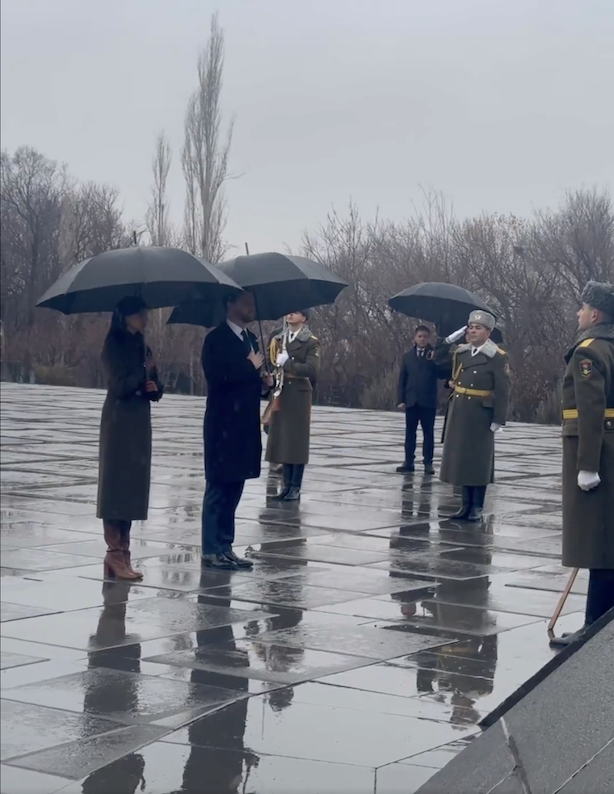
U.S. Vice President and Second Lady JD and Usha Vance visit the Armenian Genocide Memorial Complex during their visit in February 2026.
For Armenia, religious and national identity are deeply intertwined, and this has a deep impact on how its people respond to shocks such as the Nagorno-Karabakh conflict. Approximately 97 percent of Armenia’s population identifies as Armenian Apostolic, with the remainder comprising of Roman Catholics, Protestants, Yezidis, Jews, Muslims, and other small communities. The Armenian Apostolic Church, which dates to the 4th century, has served as the primary custodian of Armenian civilization, language, and identity. It also shapes how many Armenians understand sovereignty and history.
This identity is inseparable from the memory of the Armenian Genocide. Between 1915 and 1923, an estimated 1.5 million Armenians died at the hands of the Ottoman Turkish government through death marches, mass executions, starvation, and disease. This has become the defining trauma of Armenian collective memory, the lens through which subsequent threats are interpreted. For many Armenians, the Nagorno-Karabakh conflict is not simply a territorial dispute, but a continuation of an existential campaign, now led by Azerbaijan with the backing of Turkey, to complete the elimination of the Armenian people from their homeland. In September 2023, 100,000 ethnic Armenians—representing virtually the entire remaining population of Nagorno-Karabakh—fled to Armenia in the face of an Azerbaijani military offensive. In the span of a week, a community that had inhabited the region for centuries effectively ceased to exist.
The loss shattered public confidence in Armenia Prime Minister Pashinyan’s government and ignited a political crisis. When he moved toward a peace agreement that many Armenians saw as a capitulation, senior Armenian Apostolic Church leaders openly challenged the process. The government responded harshly, publicly attacking church leaders. The conflict has polarized society, weakening the societal unity that Armenia desperately needs in a moment of geopolitical vulnerability.
Azerbaijan: Strategic Momentum and Reputational Risks
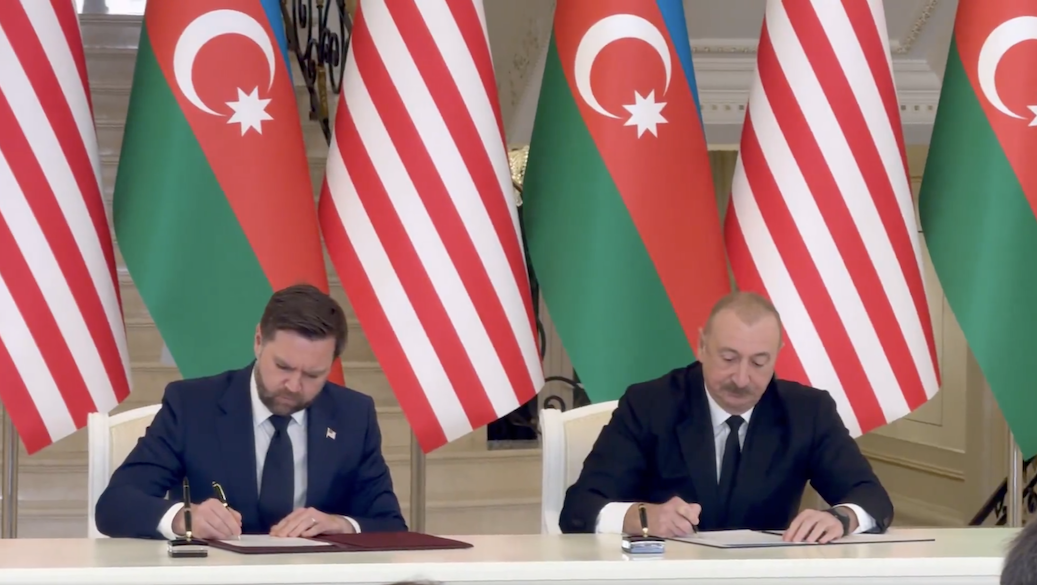
U.S. Vice President JD Vance and Azerbaijan President Ilham Aliyev sign a strategic partnership charter during Vance’s February 2026 visit.
Azerbaijan presents a very different religious profile. While the country is predominantly Muslim—approximately 96 percent of the population—its government is emphatically secular and exercises heavy-handed control over religious life, a legacy of Soviet rule.[1] Under this political framework, Azerbaijan has enjoyed peaceful coexistence among its religious communities, which is particularly notable for a Muslim-majority country. Azerbaijan’s Jewish community has roots stretching back over two millennia and represents one of the oldest continuously inhabited Jewish communities in the world. They have remained a visible and largely protected presence in Azerbaijani society even throughout the period following Hamas’ October 7th attack and the Israeli response. Moreover, Azerbaijan has cultivated a strategically important relationship with Israel, which has been a major supplier of advanced military technology to Baku.
At the same time, Azerbaijan faces a significant image challenge among a portion of the American public, particularly evangelicals, from whom Armenia enjoys genuine and deep sympathy. During Vice President Vance’s February visit to Armenia, he described it as “one of the oldest Christian nations in the entire world, a true bedrock of Christian civilization and culture.” The Armenian-American diaspora has sought to frame the Armenia-Azerbaijan conflict as religious and existential in nature: Azeri Muslims seeking to exterminate Armenian Christians in a repeat of the Armenian Genocide. This framing does not give the complete picture, but it has real political traction among American Christians who wield significant influence in the Trump administration.
How Baku handles the situation of both displaced and remaining ethnic Armenians in and their religious heritage sites in the Nagorno-Karabakh region will impact not only regional dynamics, but also its strategic relationship with Washington.
The United States: Balancing Geopolitics and Religious Dynamics
In Washington, the Armenia-Azerbaijan issue is not a high-profile topic for most Americans. However, American evangelical leaders have been vocal in raising concerns about Azerbaijan’s conduct, and this constituency has real influence in the current White House. During the International Religious Freedom Summit held in February in Washington, DC, the plight of the indigenous Armenian population of Nagorno-Karabakh was featured quite prominently.
On the other side of the ledger, pro-Israel voices in the American Jewish community have been supportive of U.S. engagement with Azerbaijan, reflecting the depth of the Israel-Azerbaijan relationship. This creates an unusual and underappreciated dynamic in which two of the more influential religious constituencies in American political life are pulling in different directions on the same regional issue.
For now, the Trump administration’s approach is primarily geopolitical in its logic: weaken Russian and Chinese influence in the South Caucasus, secure critical mineral access, advance the TRIPP corridor, and maintain peace and balance of power between Yerevan and Baku. Vice President Vance’s trip to both capitals in sequence was itself a demonstration of the balancing act. But as the peace process moves from declaration to implementation, the religious dynamics will need to be addressed.
The Path Ahead: Prospects and Risks
At the moment, Azerbaijan possesses favorable strategic momentum. It has the region’s most robust energy resources, a stable domestic political environment, dominant military capabilities, and strategic partnerships with key players including Israel, the United States, and Turkey. The risk that needs to be actively managed is reputational, particularly among American Christian communities. Tangible steps to address the needs of ethnic Armenians in Nagorno-Karabakh such as the restoration and protection of Armenian sacred religious sites would reinforce the government’s efforts to showcase Azerbaijan as a rare model of peaceful religious coexistence in a Muslim-majority nation.
For Armenia, its geopolitical position is precarious, and some of this vulnerability is self-inflicted. The conflict between the church and state has given rise to increasing societal polarization and division, thereby further weakening the nation’s strategic position and potentially its national autonomy. Armenia’s political and church leaders will need to summon the deepest treasures of their Christian faith, exercising humility, patience, and forgiveness, in order to heal society’s fractures and foster national unity in the face of an adverse security environment.
For the United States, the challenge is to build upon the positive momentum from the August 2025 White House peace summit and Vice President Vance’s February visit while maintaining a balance of power between Armenia and Azerbaijan. This could mean exploring a role for American faith and civil society leaders to both support reconciliation in Armenia and post-conflict recovery and protection of ethnic Armenian communities in Azerbaijan.
[1] Global Religious Freedom Index 2024-2026: Post-Communist Eastern Europe and Central Asia, International Institute for Religious Freedom, August 1, 2025, https://iirf.global/publications/reports/global-religious-freedom-index-2024-2026-post-communist-eastern-europe-and-central-asia/.