 Search

Credit: Kachin News Group
A Story of Perseverance, Progress, and Preservation in Myanmar
By Seng Mai Aung, Hyeyeon Park, and Tala Alnasser
This is the sixth and final in a series of articles telling the stories of students and teachers in Myanmar who have forged on with education in spite of being displaced from their homes due to the ongoing civil war that is stretching into its fifth year.
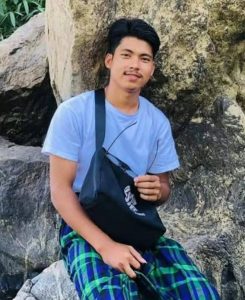 Zau Dan Awng grew up in a family of modest means in the village of Lan Lung, a small community in the Kachin region of Myanmar. His father provided for their family by driving a tricycle truck while his mother stayed at home to care for Zau Dan Awng and his three siblings. Zau Dan Awng was the second of two boys and two girls. His older sister had already made the family proud by graduating from Mai Ja Yang College and serving in the Kachin Independence Organization (KIO) while his younger brother and sister were still in school.
Though Zau Dan Awng had hopes of continuing his education, the path was not easy. After graduating from high school in 2021-2022, he briefly attended Mai Ja Yang College. However, his parents, who were struggling to support the family, could not afford the high costs of tuition, forcing him to drop out.
As he was pondering his future, Zau Dan Awng heard about Kachin State Comprehensive University (KSCU) opening in Laiza, and his hopes for further education were rekindled. He wanted to continue studying and make something of himself, but he also knew that his family needed him. His younger brother was in 10th grade, and his youngest sister was still in the 5th grade. Though KIO had initiated a return and resettlement program in their home village, Zau Dan Awng’s family had not returned to Lan Lung village since they fled due to war in 2011.
“Our home is gone now,” he said. “We will have to rebuild everything from scratch, and it will take time to save up and make that happen.”
Zau Dan Awng’s memories of the war were still vivid. In 2011, when the conflict resumed, he was just a first grader. He had barely started school when his family had to flee to Laiza. From there, they were moved to Je Yang Internally Displaced Persons (IDP) camp, a 30-minute drive from Laiza, where he continued his education.
Then he enrolled as a student at KSCU, majoring in zoology. Despite his circumstances, Zau Dan Awng was determined to keep going. The lecturers at KSCU had high hopes for their first batch of students, expecting them to become future leaders and educators. Encouraged by their belief in him, Zau Dan Awng pushed through the obstacles.
But grit alone was not sufficient, for his journey was filled with challenges. The commute from Je Yang IDP camp to Laiza was difficult, especially during the rainy season when the roads became muddy. And with rising gas prices, he often struggled to afford the fuel he needed to get to school. There were times when his motorcycle would run out of gas on the way to class, leaving him stranded.
“If I drive too fast, my clothes get covered in mud,” he explained. “But if I drive too slow, I’ll be late for class.”
Group assignments added to the difficulty. His friends lived in Laiza, while he was in Je Yang camp. Traveling back and forth for group discussions was not feasible, so he relied on Wi-Fi and messaging apps to communicate with his classmates.
However, where many fall helpless in the face of difficult circumstances, Zau Dan Awng’s passion for zoology only grew. As he studied, he began to understand the importance of preserving the wildlife in his region. In Kachin land, there were no proper laws or regulations to protect animals. People hunted without restriction, and many species were on the verge of extinction. Fishing methods like electroshocking and bombing had decimated fish populations, and once-abundant animals were disappearing from the land.
Zau Dan Awng felt a sense of responsibility to change this. “I want to propose to the authorities here that we establish rules and regulations for hunting,” he said. “I also want to conduct research on the remaining species in our land and learn how to preserve them so they can thrive again.”
Initially, Zau Dan Awng had considered using his education for personal gain, but his perspective shifted as he recognized that young people like himself were responsible for shaping the future of Myanmar after the military rule ended.
“I realized that as a student of the revolution, it is our duty to help build a nation,” he reflected. “If we lose interest in using our skills to help build the country, all the sacrifices made by young people for our liberation will be wasted.”
Zau Dan Awng’s sense of duty was deepened after he participated in a special lecture series organized by the Institute for Global Engagement (IGE) and the International Center for Law and Religion Studies (ICLRS) with international professors. He was particularly struck by a lecture on oppression, which resonated with the struggles he saw in his own society. The rich and powerful monopolized opportunities, while the poor—often young men from struggling families—were forced into military service. The lecture opened his eyes to the global nature of this issue. He realized that oppression was a universal language, understood not just by locals around him, but people experiencing it worldwide. He felt empowered by the knowledge shared by the lecturers and inspired by their stories.
“I never thought I would have the chance to participate in such a program,” Zau Dan Awng said. “I now want to learn more about my rights, how to protect them, and what opportunities are out there for young people like me.”
For Zau Dan Awng, education had become much more than just a means to earn a living. It was a way to contribute to the future of his people and his nation. As Zau Dan Awng continued his studies, he envisioned himself using his knowledge to protect the natural world in Kachin land. He resolved to not only restore his family’s village but also preserve the rich wildlife of his homeland and to lead his peers in the effort to build a better future for Myanmar. His journey was not easy, but he was determined to make the sacrifices worthwhile—for himself, for his family, and for the generations that will follow.
Conclusion
Despite over seven decades of systemic oppression that has broken trust and deepened isolation, there are those whose genuine care and dedication inspire change. In Laiza, teachers, mentors, and volunteers have worked tirelessly to invite the younger generation to strive for a brighter future. By providing education and fostering connections with international institutions through exchange and training programs, they have created new opportunities and opened pathways that once seemed impossible.
These efforts offer a beacon of hope, both for the students and the fractured relationships between communities in Myanmar. The individuals’ dedication serves as a testament to how community-building is achievable even in dire conditions. Amidst conflict, dreaming becomes a necessity. One may be stripped of his home and people, but his dreams are his own, and can be actualized by a personal conviction to pursue them.
________________________________________
About the Authors
Seng Mai Aung is a Senior Program Officer at the Institute for Global Engagement.
Hyeyeon Park interned at IGE and is a senior at Pepperdine University majoring in Psychology and double minoring in Industrial Organization and Social Work.
Tala Alnasser interned at IGE and is a senior at Brigham Young University majoring in French Studies and Communication with an emphasis on Public Relations and minoring Sociology.