 Search

The Team I Carry Within Me for Nation-Rebuilding
A nation is rebuilt in many ways, not only by those who stand on its frontlines, but also by those who quietly carry its future across distant lands. Some remain on the frontlines, while others carry the same commitment across borders, holding onto the hope of returning with something more to give.
I come from a place often reduced to headlines of conflict and instability but rarely understood through the lives of the people who endure it. In Kachinland, Burma/Myanmar, history does not feel like the past. It is everywhere: in conversations, in silence, and in the small ways people try to survive. For decades, promises of peace, autonomy, and a shared future were made by those in power, only to be broken repeatedly under long periods of dictatorship that prioritized power over people. The result has been not only political failure, but something deeper: a slow, generational erosion of trust, hope, and the ability to imagine a different future. Families have remained displaced for more than 15 years. Children grow up knowing fear more than safety and stability.
I came to the United States in 2023 as an international student to study law, at a time when some of the most intense fighting against the regime was taking place in my homeland. During my first year of law school, while I sat in classrooms, some of those on the frontlines were my friends. Some of them I have already lost, while others continue to fight. There were moments when I questioned the path I had chosen and I had always felt a quiet sense of guilt, knowing that I could offer so little at a time when so many chaotic situations are daily struggles for those who stayed. Studying abroad while knowing the homeland remains under bombs and airstrikes is not easy. It brings a constant sense of uncertainty. But this has never stopped me from hoping to return. If anything, it has strengthened my desire to become part of the change I wish to see.
In ways I did not expect, I began to find a form of healing through the diaspora community. It became a space where my language is spoken and where shared experiences, collective trauma, and a deep love for the homeland come together with the hope of seeing it governed with justice. There, I found a space to process, reflect, and continue. Through my involvement with Kachin Alliance and the broader diaspora community, I noticed something I had not fully realized. Beyond shared grief and concern, there were sparks of ideas, resilience, and a collective willingness to contribute across generations. What surprised me most was seeing those sparks burn so strongly among young Kachins in the diaspora.
Before becoming involved in the diaspora Kachin community, I understood the diaspora as a voice, one that spoke on behalf of those back home from different parts of the world. But I had not imagined that younger generations, raised far from the homeland, would still carry such a strong sense of being Kachin, how firmly they would hold that identity, or how willingly they would choose to be known by it. I once assumed such spirit lived mainly with the older diaspora generation, and that distance might have weakened it among the young. Instead, I found something different. Many young diaspora Kachins remain deeply connected to their identity and are actively imagining how they can help rebuild the nation and serve the homeland in whatever ways they can. That spirit did not emerge on its own; it has been quietly nurtured by parents and earlier generations who, even far from home, have kept alive a sense of belonging, responsibility, and love for the homeland.
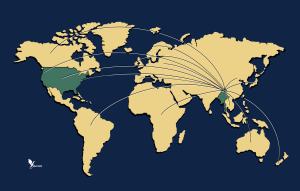
I had always imagined my return to the homeland as something I would do alone, joining an existing nation-rebuilding process after completing my studies in the United States. But over time, that vision began to shift. I started to see the possibility of returning not alone, but with a “team” I carry within me, one that exists beyond physical presence. It is a collective spirit of young Kachins in the diaspora, connected across distance, carrying the weight of the past while remaining determined to help shape a different future, even far from the homeland.
This reminds me of the idea of an “imagined community,” described by political scientist and historian Benedict Anderson, where a nation is built not only through physical closeness, but through a shared sense of belonging among people who may never meet. I see this in the spirit of young Kachins in the diaspora. Even without direct experience of living through the conflict, many still choose to stay connected, to learn, and to remain involved.
For someone preparing to return to the ongoing realities of conflict and the long path toward rebuilding the homeland, I have come to see this collective spirit as a source of strength. Their commitment, youthful energy, and willingness to contribute have become part of what I carry home: a growing network of people, ideas, and support that continues beyond distance. What remains is the question of how to sustain this connection across places, from the United States back to Kachinland, and beyond borders. Connection does not sustain itself. It requires care, intention, and people willing to keep it alive. In many ways, it feels like tending a flame, something that depends on someone willing to carry it across distance, protect it and keep it alive until it can burn on its own.
I am not in the United States simply as an international student pursuing a degree. I am here with a mission: to help keep the spark alive across distance, and one day carry its light gently back home. Each conversation, each relationship, and each shared idea become part of something larger.
Nation-rebuilding requires a wide range of capacities across different sectors. What I have come to realize is that some of these capacities already exist beyond our borders. It is both meaningful and hopeful to see them taking shape within the diaspora. The challenge, and the opportunity, lies in how we bring these capacities together and use them strategically.
What I am trying to build is not entirely new, but something already taking shape in many ways. Research from the Joan B. Kroc Institute for Peace and Justice at the University of San Diego shows that Burmese/Myanmar women in the diaspora are actively building peace from afar through advocacy, community work, and transnational networks. Even while facing many challenges, they continue to support their communities and work toward a more just and inclusive future.
To young people studying across different parts of the world, and hoping to return one day, whether we know each other or not, I encourage you to stay connected with the diaspora community wherever you are. Build relationships, especially with other young people who share the same sense of belonging. In doing so, you become a bridge, carrying connection across distance and helping close the space between those abroad and those at home. What may seem like small conversations and simple moments can grow into something greater: a network of people, ideas and strength that may one day return together. In this way, even while far from home, you are already part of the nation-rebuilding process.
Perhaps the work of rebuilding a nation begins long before returning home, in the connections we carry, the relationships we nurture, and the responsibilities we choose not to let go.