 Search

Photo by Luwadlin Bosman on Unsplash
Broken Open, Not Broken Apart: A Faith-based Model of Resilience for Women Leaders
Ask most people what resilience looks like, and they will describe something athletic: a person knocked down who gets back up, brushes herself off, and keeps going. Words like grit, toughness, and bounce-back come to mind. In popular imagination, resilience is a display of strength.
The women whose stories form the foundation of the Faith-Anchored Dynamic Resilience (FADR) Model might not recognize themselves in that description. The model was developed from a series of first-person narratives through iterative cross-cohort analysis and theoretical synthesis, aiming to capture the full complexity of how faith-anchored women navigate adversity.[i]
The women whose stories shaped the FADR model come from diverse faith backgrounds, including Protestant, Catholic, Muslim, Buddhist, and Hindu, and are from countries such as Nigeria, Kenya, Myanmar, Uzbekistan, the United States, Egypt, Cameroon, Afghanistan, and others. They have faced challenges like refugee displacement, HIV diagnoses, losing a child, institutional discrimination, career setbacks, and years of service without hope of recognition. Some have been truly broken. This model shows that their breaking was not a failure of resilience but a crucial part of it.
What makes these women’s stories hard to fit into traditional resilience models isn’t just how severe their challenges are; it’s how their lives developed. These are not simple stories of overcoming obstacles and bouncing back. They are nonlinear, full of detours that become destinations, losses that turn into foundations, and moments of apparent collapse that lead to deep growth.
The FADR model is also distinctly informed by chaos theory,[ii] which helps explain how complex systems behave unpredictably but still follow underlying patterns and provides a better description of these women’s lives than the bounce-back metaphor ever could. It introduces concepts such as bifurcation points, strange attractors, and the edge of chaos that, when applied to these stories, reveal not only what happened to them but also why resilience in a complex human life could never look different.
What the Model Proposes
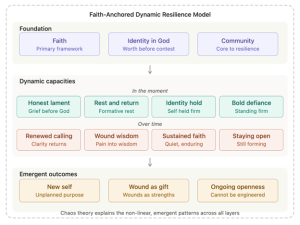
The FADR Model structures resilience into three layers: Foundation, Dynamic Capacities, and Emergent Outcomes, with chaos theory adding another layer that explains why resilience in complex human lives is non-linear, surprising, and never driven solely by willpower.
The Foundation
Three elements are essential prerequisites.
- First, faith, not just a background feature but the primary framework through which adversity is understood and managed.
- Second, a God-centered identity: the belief that worth is established before it is challenged and does not depend on institutional recognition or positive outcomes.
- Third, community, not merely a support network but something structurally vital to resilience itself.
Dynamic Capacities
The model identifies eight practices organized into two groups. The first group emphasizes resilience in the moment:
- honest lament (expressing the full range of grief, anger, and doubt to God rather than suppressing it);
- rest and return (intentional, formative withdrawal, not passive recovery);
- identity (maintaining a God-grounded sense of self amid ongoing pressure to diminish); and
- bold defiance (standing firm in one’s calling despite social or institutional resistance).
The second cluster emphasizes resilience over time:
- renewed calling (returning to one’s vocation after disillusionment with greater clarity, not erasure);
- wound wisdom (transforming personal suffering into empathy and strength rather than being defined by it);
- sustained faithfulness (the quiet, enduring form of resilience, simply remaining present over decades); and
- staying open (the ongoing willingness to be shaped further, even after years of demanding service).
Emergent Outcomes
The model’s most striking claim is that the deepest outcomes of resilience cannot be intentionally planned. None of these women set out to become the person they ultimately became. Three themes emerge from the stories: a new self, a purpose more aligned with the world’s needs than anything they initially envisioned; the wound as a gift, the clear, traceable transformation of specific wounds into vocational strengths; and ongoing openness, the hard-earned wisdom that the most meaningful developments in life cannot be controlled, only embraced.
The Chaos Theory Layer
Chaos theory can explain why resilience in these lives acts the way it does—non-linearly, unpredictably, yet still following recognizable patterns. Five concepts from chaos theory directly shed light on the model.
Sensitive dependence on initial conditions shows that small early inputs, such as a school near a church, a mentor’s single encouraging question, or a scripture received at a prayer meeting, accumulate over time, leading to very different life paths.
Bifurcation points are moments of instability when a life may shift in many directions: an HIV diagnosis, a career-ending injury, a crisis of faith after a loss. These are times when ordinary resilience is not enough, and a foundation must already be in place.
Strange attractors represent persistent calling patterns that flow through nonlinear life journeys; detours are not disruptions; they revolve around the attractor.
The edge of chaos is the creative zone between strict order and total disorder, where the most meaningful transformations can occur. Liminal seasons, unemployment, grief, and vocational uncertainty are not problems to be solved; they are creative states.
Lastly, emergence describes the model’s outcome layer: it self-organizes and cannot be forced, only prepared for by deliberately allowing life to unfold.
What the Research Says
The FADR Model was developed inductively from first-person narratives. Testing it against the broader empirical landscape shows both strong support and real challenges.
Regarding faith as a resource for structural resilience, the evidence is mostly confirmatory. Research consistently shows a moderately positive link between spirituality and resilience, mainly through meaning-making: the ability to interpret adversity within a larger context.
However, the specific content of a theological framework is critically important. Theology centered on divine punishment or spiritual inadequacy can hinder resilience. The model reflects the sustaining power of faith but doesn’t fully explain how institutional religion can sometimes undermine the women it aims to support, a conflict that the sociology of religion literature describes with measurable health impacts.
Regarding community as a framework for resilience, research supports the model’s claim, although mainstream psychological frameworks have been slow to adopt it. Most widely used resilience measurement tools, including the Connor-Davidson Resilience Scale, were designed to assess individual traits. When used with women whose resilience is primarily communal, these tools underestimate this form of resilience.
Regarding non-linearity, the evidence is strong. Research consistently indicates that women face more external bifurcation points in their leadership growth, not because of personal flaws but due to structural conditions. What seems like a detour or delay often becomes the site of the deepest growth.
Within chaos theory as an explanatory framework, the FADR Model is well-positioned. Career development researchers had already been applying chaos theory to human vocational paths before this model was created, and they recognized spirituality as a key feature of complex adaptive careers. However, critics correctly point out that ideas from chaos theory are often used more as powerful metaphors than as strictly mathematical frameworks. The FADR Model uses chaos theory interpretively, not for prediction, and its value lies in highlighting patterns rather than producing precise forecasts.
Questions That Remain
Three questions deserve exploration going forward. First, can secular women demonstrate the same resilience patterns? The model states that faith is essential, not just optional; it is the interpretive framework that drives dynamic abilities. Research on meaning-making shows that non-theological frameworks can work similarly, and that the specific content of any belief system affects whether it supports or hinders resilience. The model’s strongest claim can also be its most debated.
Second, how does the model address resilience when it fails? Every woman in this collection ultimately persisted. The same combination of bifurcation points and structural challenges that led to transformation in these lives can also cause breakdown in others. The model suggests that the foundation must be solid before a crisis occurs, but offers less guidance on how to build it when early stable conditions, like some of these women experienced, are absent.
Third, what does the model suggest for institutions that support women leaders? If the FADR Model is correct about structural non-linearity, then perceived detours often serve as the deepest areas of growth. Institutions that pressure women to redeploy quickly after departure, demand measurable results during chaotic times, or see lament and doubt as problems to fix are actively working against the very processes that foster the strongest resilience. Research confirms this: the most effective institutions for developing resilient women leaders are those that create space for adversity to shape, rather than trying to erase it as soon as possible.
Conclusion
After reviewing both the narratives and research, the combined definition of the FADR Model is as follows:
Resilience, in the lives of these women, is the faith-based ability of a complex human system to stay aligned with its true calling, through moments of extreme instability, across nonlinear seasons of loss and uncertainty, supported by a community whose care is structural rather than optional, relying on active practices such as honest lament, discernment in withdrawal, maintaining one’s identity integrity, bold defiance, vocational renewal, wound integration, steadfast faithfulness, and ongoing openness, until what manifests is not a return to an old self but a vocation more aligned with the world’s needs than anything intentionally designed.
What the research adds to this definition is both confirmation and a challenge: confirmation that faith, community, and non-linear development are empirically recognized as vital to resilience. It also challenges the idea that the content of faith matters, that institutional religion can either undermine or support resilience, that most measurement tools are inadequate in capturing what these women have demonstrated, and that while the chaos theory layer is structurally illuminating, it remains an analogy rather than conclusive proof.
One additional point deserves emphasis. Research published in Frontiers in Psychology (2025) clearly highlights the dominance of Western, educated, industrialized populations in the resilience literature.[iii] Most empirical studies on faith and resilience have been carried out in North America and Western Europe. In contrast, the women whose stories form the basis of the FADR Model are mainly from sub-Saharan Africa, Southeast Asia, Central Asia, and the Middle East. The FADR Model, which analyzes over 50 narratives from non-Western women in leadership, marks an important step toward closing this gap—and reminds us to be cautious about assuming Western findings are universally applicable.
These women are not resilient because life became easier or because their callings were finally recognized. They are resilient because they continued to draw from a source that never runs dry and because they were willing, through every season of difficulty, to remain broken open rather than broken apart. That, in the end, is what the FADR Model describes: not the strength of exceptional individuals, but the faithfulness of ordinary people sustained by something larger than themselves, shaped by communities they did not choose alone, and called toward a purpose they could not have designed.
[i] The AI tool Claude was utilized to help identify the main themes of the essays.
[ii] Oestreicher, Christian. 2007. “A History of Chaos Theory.” Dialogues in Clinical Neuroscience 9(3): 279–289.
[iii] I-Thani, H. 2025. “Religion and Spiritual Well-being: A Qualitative Exploration in Qatar and its Challenge to Western Well-being Paradigms.” Frontiers in Psychology 16.